
#4: Dear Mr. M // Herman Koch
Fiction | Paperback | 400 pages
I've been on a fiction binge this month, as I tend to do when work gets hectic and the brainpower required for reading non-fiction begins to make it feel like more work. Thus, the my 4th read of 2017 brought me to the Dutch writer Herman Koch's Dear Mr. M, my first read by this author. Here's what I thought.
Fiction | Paperback | 400 pages
I've been on a fiction binge this month, as I tend to do when work gets hectic and the brainpower required for reading non-fiction begins to make it feel like more work. Thus, the my 4th read of 2017 brought me to the Dutch writer Herman Koch's Dear Mr. M, my first read by this author. Here's what I thought.
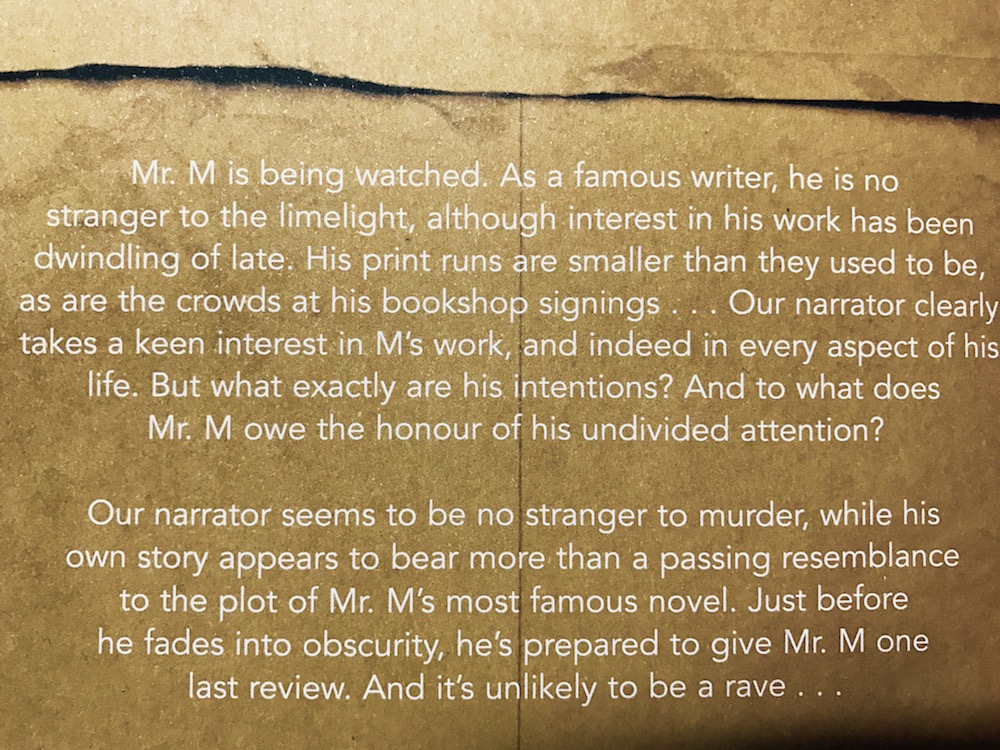
First of all, have a look at the blurb:
Fascinating, right? That's what I thought, at first.
You see that there are a number of questions posed:
What's the narrator's interest in Mr. M?
What is the narrator planning?
Based on the interesting book jacket (after all, I'd had good luck with The Watchmaker of Filigree Street) and the blurb which only teases at the plot, I'd really wanted to like this book. Alas, it wasn't meant to be.
Let me save you 400 pages of trouble
Spoiler alert: You're not going to be happy with the answers to the questions above. In fact, you'll be left frustrated because there are so many more unanswered questions raised by the plot, characters you never hear from again despite being central to the story, and a fairly dissatisfying ending.
There's also all the exposition around Mr. M, despite the fact that he's the least interesting or sympathetic character in the book. While the narrator is the one driving the story, I was sorely disappointed to realize as I reached page 400 that Mr. M was the main character after all.
Leaps through time
Besides the unsatisfactory plot, my major issue with Dear Mr. M was the structure. I'm very glad I didn't listen to it as an audiobook, as the constant change of person was frustrating. One chapter is first person from the perspective of the narrator, and the next it's third person description of one of the numerous characters. Then there are the frequent leaps through time, and the unclear ages of the various characters. If you're someone who is regularly heard saying "Wait, what?" at time or perspective jumps in movies, this book will drive you crazy.
You guessed it:
I cannot recommend this book
Between the fragmented structure, the boring outcome, and the fact that this story was entirely too long, I really cannot suggest this book to anyone unless perhaps it's in the original Dutch. Given the success of Herman Koch, my guess is that there's a reason he has a following, and perhaps that reason has gotten lost in the translation of Dear. Mr. M. Then there's that misleading blurb.
Based on reviews I've read since finishing this novel, perhaps you can consider looking up some of Koch's earlier works, which numerous reviewers emphasized were much better than this book. As for me, I should probably stop being taken in by interesting cover designs
(PS: The header photo was edited with the PicCollage app, made by a Taiwanese startup!)



What's up next?
The Obesity Code (Non-Fiction) by Dr. Jason Fung
The Readers of Broken Wheel Recommend (Fiction) by Katarina Bivald
Quiet (Non-Fiction) by Susan Cain
Subscribe below to get the latest in your inbox. I'll do my best to keep it interesting!
#1: A Hologram for the King // Dave Eggers
Fiction | Paperback | 312 pages
I picked up this novel without much thought during a book binge at Eslite in December, one of half a dozen paperbacks grabbed from the promotional tables near the registers. After quickly reading another of my book binge finds, Orphan Train (recommended!), I thought I’d be able to finish another story by the end of 2016, but alas, it is now a new year and A Hologram for the King has become my first book of 2017. Here’s my review.
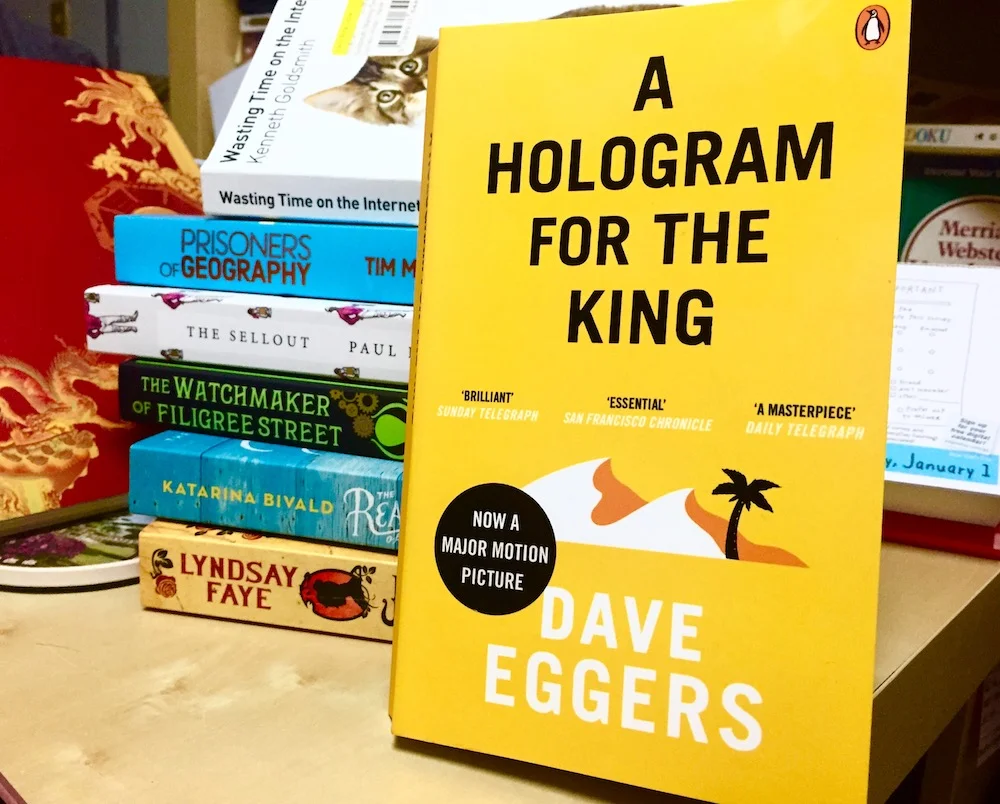
Fiction | Paperback | 312 pages
I picked up this novel during a book binge at Eslite in December, one of half a dozen paperbacks grabbed from the promotional tables near the registers. For whatever reason, I tend to be less picky when choosing from bookstores, and never leave with fewer than five books in tow. It may be that I'm a sucker for nice displays, or perhaps it’s due to the lack of reviews that might drive me off. Point being, I bought this particular book without much thought.
After quickly reading another of my book binge finds, Orphan Train (recommended!), I thought I’d be able to finish another story by the end of 2016, but alas, it is now a new year and A Hologram for the King has become my first book of 2017. Here’s my review.
The bad news
Unfortunately, though I’d like to be able to say my 2017 reading is off to a good start, I found Eggers’s rambling narrative immensely sad. In this version of the cliched fish out of water tale, Alan Clay is a middle-aged white guy dispatched to a foreign land for a work assignment. Sound familiar?
Throughout the story, I found myself thinking I might have liked it more if I’d never seen Lost in Translation. Just as with Bill Murray in Coppola’s take on Tokyo, the world Clay encounters in Saudi Arabia is populated by unusual characters who contribute a touch of levity. And yet, you just know from the start that not one of the people in the story is going to be happy by the end. Changed, yes. Happy, no.
Perhaps if I’d listened to the Lost in Translation soundtrack while reading, I may have enjoyed this novel. Perhaps not.
The good news
Over the years, I’ve learned that no book is a waste of time, even if you don’t particularly like the content. There is always something to be learned. Here are a few things I learned from/after reading A Hologram for the King:
1. A movie version was released in April 2016
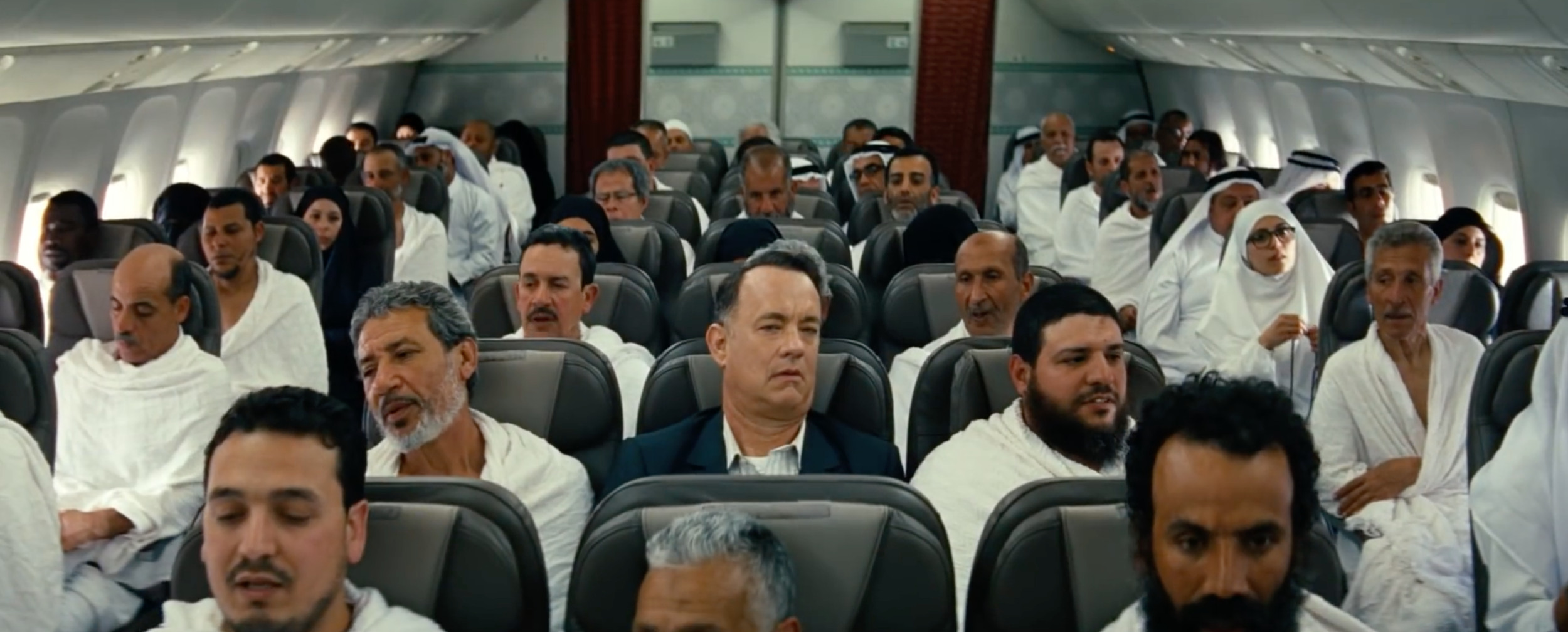
Naturally, it was after reaching the final page that I noticed the sticker on the bcover, proclaiming NOW A MAJOR MOTION PICTURE. A quick Google told me that the screen version of Alan Clay was portrayed by Tom Hanks (with his dad played by a now 83-year-old Tom Skerritt!), and that the film only took in US $7.8 million on a $30 million budget. Even the best actor who’s ever lived, Tom Hanks, couldn’t save this depressing story, and according to Wikipedia it was his worst flop in 30 years. See for yourself:
2. The book’s setting is real…ish

It was also after finishing the book that I learned that King Abdullah Economic City, Clay’s destination in the story, does in fact exist. And like the fictionalized version in Eggers’s novel, the real KAEC has a certain aura of the surreal about it. If you check out the official website and view its associated Facebook page, YouTube channel, and other social media accounts, you’ll notice the content is primarily drawn from the same source video, recycled and reconfigured over the past two years into new content. While you can find plenty of English language reporting over the past couple of years about the economic troubles of Saudi Arabia, there is very little recent reporting about KAEC itself that is not from an official press release.
Probably the best way to learn more about KAEC is to go there — if you’re looking for a new adventure in 2017 and moving to Saudi Arabia seems like a good personal choice, may I direct you to the recruiting page? Even women are welcome to apply.
3. There’s much to be learned about Middle Eastern fashion
Since A Hologram for the King includes numerous descriptions of what people are wearing, and given that I've never traveled to Saudi Arabia or anywhere else in the region, I had to do more Googles to be able to picture some of the characters in the novel. Down the rabbit holes of Wikipedia and YouTube and back out again, now I know a thing or two about thobes and how there’s no one correct way to wear a ghutra, but more importantly, I’ve got a better picture of the scale of what I do not know. But hey, knowing what you don't know is the first step in learning, right? If you’d like to learn a thing or two, here’s a good place to start:
Note: This video is from Qatar rather than Saudi Arabia, though the basics are similar.
—
And that’s all for book #1 of 2017 and the year's first book review. For some background, after 2 years in a row of successfully reading at least 52 books in 52 weeks, I decided a couple months back that my writing could also use some work. Writing reviews of what I'm reading is my way of upping the ante in 2017.
Stay tuned for reviews of other current reads, including:
Wasting Time on the Internet (Non-Fiction) by Kenneth Goldsmith
Monkey Mind (Non-Fiction) by Daniel Smith
The Watchmaker of Filigree Street (Fiction) by Natasha Pulley
To avoid missing out, be sure to subscribe below!
Non-Fiction | Audiobook | 11h30m
When it comes to the non-fiction books that really stick with me, I'd say books about the future rank mostly highly. Kevin Kelly's The Inevitable is one of a number of books published in 2016 dealing with technological evolution and how it will impact our world -- should you read it? Here's my opinion.