
What I'm Reading: Going Solo // Eric Klinenberg
This is my 86th read of 2018, though I’ve been working my way through it for a few months already. Eric Klinenberg’s Going Solo sheds light on the rising trend of living alone, which I can related to as the head of a one-person, one-dog, one-cat household. Is solo living or good bad for societies and individuals? Let’s find out.
Non-Fiction | Kindle
I've read/listened to some 180+ books since writing my last book review, but as I've also been traveling for work or preparing to travel somewhere during much of that time, needless to say there's no way I could keep up with reviewing them all. Since I've had a several people comment lately that they wish I'd share more of my reading, here's a random post, and it's a wordy one, poorly edited. Better done than perfect, right? More to come, if there's time.
Why I chose this book
Going Solo: The Extraordinary Rise and Surprising Appeal of Living Alone piqued my curiosity due to the fact that I live alone, as do the majority of unmarried foreign residents in my social circle in Taiwan. Likewise, back in the US, most acquaintances of my generation have experienced solo living at some point between high school and marriage. Contrast that with my acquaintances in Taiwan, many of whom have never lived alone, often going from living with their parents directly to living with a spouse, perhaps sharing an apartment with roommates briefly in between.
What it's about
Going Solo examines the causes for the rise in solo living, primarily in the west, as well as how society has adapted to this modern way of living. To be clear, this book is not purely about people who actively choose to remain unmarried their whole lives (though this particular segment of singletons is growing). It is also about people who are single due to the death of a spouse, divorce, or just being unlucky in the romance department. Regardless of the reasons people live alone, the problem remains that our cities, laws, and social structures are optimized for married couples with children, and these need to evolve in order to maintain the quality of life of people who are on their own.
I won’t summarize the book, but will hit on three areas it caused me to think more deeply about, whether explicitly mentioned in the book or due to my own extrapolation:
Takeaway #1: Societies that try to discourage singledom do so at their own peril
While Going Solo mostly talks about western societies, I live in a country that looks nothing like those described in the book. Here in Taiwan, falling birth rates have been making headlines since before I arrived in 2005, and the government has attempted to prevent a reversal in population growth largely through financial incentives for married couples. More recently, it appears that some folks have started to realize it may be easier to bring in adult professionals than to “create” future adults (babies!), so making Taiwan more open and international has become a new priority. I’m a strong proponent of internationalization, of course, but what about that birth rate crisis?
To be clear, wage stagnation and the rising cost of living in cities are major factors in why young people are delaying marriage and having fewer children. But the continued emphasis on maintaining the outdated notion of the “nuclear family” is also to blame. In a society where only married women can receive IVF treatments (though single women can freeze their eggs), artificial insemination is not legal for single women, and gay couples may not adopt or engage surrogate mothers, the law actively discourages conception and child-rearing by any type of family unit besides that of heterosexual married couples.
Though women in Taiwan are marrying later and seeing their earnings rise, those who, either by choice or by circumstance, do not marry but still have the means and desire to have children, cannot do so without facing legal or logistical obstacles. Thus, choosing singledom is often by default choosing childlessness. Removing legal obstacles for single people (and gay couples) to choose parenthood would not singlehandedly fix the birth rate problem, but it would bring the law in line with evolving societal views on what qualifies as a “family unit” and make parenthood more accessible to single people who would love to have children if only there were legal, local options.
Takeaway #2: Technology isn't really all that isolating
The book briefly touches on this topic, specifically with regards to studies that imply increased time spent online is a problem while ignoring the fact that much of the online world is inherently social. The argument some people make against solo living is that the internet is no substitute for face to face interaction.
Those who live alone don’t necessarily feel isolated, even if their social lives aren’t quite the kind of “social” we’d have recognized 20 years ago. We stopped calling people when chat programs like ICQ and AOL Instant Messenger became easier ways to get in touch. We mostly stopped handwriting letters when we became capable of instantaneously reaching others through email. And though I wasn’t alive back then, I can only assume that dropping in to visit people decreased as more and more people installed telephones in their homes.
Every era has its own ideas of what it means to be social, and the mature generations of each era have surely decried the latest technologies that threatened the contemporary social norms. Yet, it’s doubtful that anyone would prefer to go back to the days of stopping in to see friends and needing to leave a calling card after discerning that no one is home. Nor would we be better off in a world where we couldn’t connect with people of other cultures and backgrounds easily, or turn weak connections into strong ones through regular online interaction.
That said, of course the internet has played a large part in the seeming loss of humanity among younger generations who’ve grown up never knowing a world without it. Trolling and online bullying are easier to engage in when we can hide behind our screens. But it’s important to note that the trolls and online bullies who have turned their verbal threats into physical violence in the real world have often been people living in multi-person households, often with their parents. Thus, living with other people doesn’t necessarily make us less isolated or more socially connected, just as living alone doesn’t equate to social isolation and loneliness.
Takeaway #3: Where governments aren’t helping, tech companies fill the gaps
As I mentioned, I live alone, and one of the greatest things about solo living in this decade is the abundance of tools that make life easier when you don’t have others in your household to share the load. Living alone means you’re responsible for all the cooking, shopping, cleaning, bill-paying, and every other thing that keeps you clean and healthy, and this can be a burden when you have a busy career and/or social life. Of course, shopping or doing laundry for one person is easier than it is for four, but when you cannot delegate a single household task, it can be tough to keep up.
Luckily, we live in an era with an abundance of apps serving people who live alone, especially for those of us who live in cities. I do wish there were as many options in Taipei as there are in other places like New York or Singapore, but here are some services (with apps) that help me to outsource things I don’t have the time for:
HonestBee: restaurant & grocery delivery, including deliveries from Costco, Carrefour, and specialty shops (now defunct
KumaWash: laundry service, with pickup and dropoff in 24 hours (also defunct)
UberEats: restaurant delivery — a lifesaver for me when I don’t have spare time to pack lunches for work
PChome & momo: household goods delivered in 24 hours, with 6-hour delivery in Taipei by PChome
(One other thing -- HonestBee briefly did on-demand garbage pickup, which is a lifesaver in Taipei when your nearest trash pickups are at 5pm and 10:05pm and you're a working professional who lives alone, goes home late, and likes to be in bed by 10pm. Still waiting for another company to fill the gap!)
There's still a lot of opportunity going forward for tech companies that serve the needs of people who live alone, whether those people are young professionals, the elderly, or people with mobility issues. Going Solo didn't touch on this nearly as much as it could have, but regardless, I'd recommend aspiring startup founders and existing companies to read this book and keep solo dwellers in mind when developing new features or products.
That's all I've got in me. If you're looking for some more reads, here are a few I've enjoyed this year:
Bad Blood by John Carreyrou (non-fiction, biz, tech, narrative)
A Gentleman in Moscow by Amor Towles (fiction, historical, long read)
Tomorrow Will Be Different by Sarah McBride (non-fiction, memoir, transgender)




#4: Dear Mr. M // Herman Koch
Fiction | Paperback | 400 pages
I've been on a fiction binge this month, as I tend to do when work gets hectic and the brainpower required for reading non-fiction begins to make it feel like more work. Thus, the my 4th read of 2017 brought me to the Dutch writer Herman Koch's Dear Mr. M, my first read by this author. Here's what I thought.
Fiction | Paperback | 400 pages
I've been on a fiction binge this month, as I tend to do when work gets hectic and the brainpower required for reading non-fiction begins to make it feel like more work. Thus, the my 4th read of 2017 brought me to the Dutch writer Herman Koch's Dear Mr. M, my first read by this author. Here's what I thought.
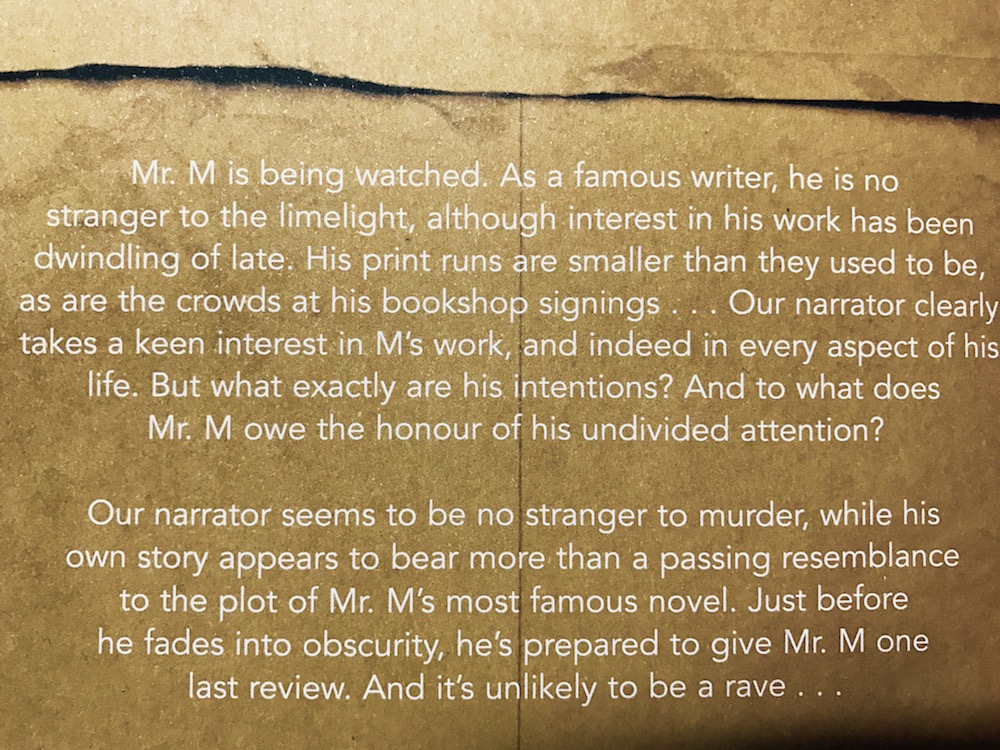
First of all, have a look at the blurb:
Fascinating, right? That's what I thought, at first.
You see that there are a number of questions posed:
What's the narrator's interest in Mr. M?
What is the narrator planning?
Based on the interesting book jacket (after all, I'd had good luck with The Watchmaker of Filigree Street) and the blurb which only teases at the plot, I'd really wanted to like this book. Alas, it wasn't meant to be.
Let me save you 400 pages of trouble
Spoiler alert: You're not going to be happy with the answers to the questions above. In fact, you'll be left frustrated because there are so many more unanswered questions raised by the plot, characters you never hear from again despite being central to the story, and a fairly dissatisfying ending.
There's also all the exposition around Mr. M, despite the fact that he's the least interesting or sympathetic character in the book. While the narrator is the one driving the story, I was sorely disappointed to realize as I reached page 400 that Mr. M was the main character after all.
Leaps through time
Besides the unsatisfactory plot, my major issue with Dear Mr. M was the structure. I'm very glad I didn't listen to it as an audiobook, as the constant change of person was frustrating. One chapter is first person from the perspective of the narrator, and the next it's third person description of one of the numerous characters. Then there are the frequent leaps through time, and the unclear ages of the various characters. If you're someone who is regularly heard saying "Wait, what?" at time or perspective jumps in movies, this book will drive you crazy.
You guessed it:
I cannot recommend this book
Between the fragmented structure, the boring outcome, and the fact that this story was entirely too long, I really cannot suggest this book to anyone unless perhaps it's in the original Dutch. Given the success of Herman Koch, my guess is that there's a reason he has a following, and perhaps that reason has gotten lost in the translation of Dear. Mr. M. Then there's that misleading blurb.
Based on reviews I've read since finishing this novel, perhaps you can consider looking up some of Koch's earlier works, which numerous reviewers emphasized were much better than this book. As for me, I should probably stop being taken in by interesting cover designs
(PS: The header photo was edited with the PicCollage app, made by a Taiwanese startup!)

What's up next?
The Obesity Code (Non-Fiction) by Dr. Jason Fung
The Readers of Broken Wheel Recommend (Fiction) by Katarina Bivald
Quiet (Non-Fiction) by Susan Cain
Subscribe below to get the latest in your inbox. I'll do my best to keep it interesting!

#3: The Watchmaker of Filigree Street // Natasha Pulley
Fiction | Paperback | 336 pages
To begin, a warning: DO NOT Google this book or read reviews before buying it, lest the ending be ruined for you. I'm certainly glad I didn't, as popping the title into Google during the writing of this review immediately displayed search suggestions with spoilers. (Come on, Google!)
With that said, The Watchmaker of Filigree Street is easily the best book I've read so far in 2017, and you should definitely read it. Here's my spoiler-free review.
Fiction / Paperback / 336 pages
This review is spoiler-free, unlike Google
To begin, a warning: DO NOT Google this book or read reviews before buying it, lest the ending be ruined for you. I'm certainly glad I didn't, as popping the title into Google during the writing of this review immediately displayed search suggestions with spoilers. (Come on, Google!)
With that said, The Watchmaker of Filigree Street is easily the best book I've read so far in 2017 (8 in total, if you're curious), and you should definitely read it. Here's my spoiler-free review.
The Basics
A fairly simple premise to start: Thaniel Steepleton is saved from death by a timepiece that mysteriously came into his possession some six months before a terrorist explosion. His search for answers brings him to Filigree Street, where he meets -- you guessed it -- the watchmaker, Mori. I'll leave off there, as any further details might take away from the fun of the story, but let's just say there's far more going on in this novel than meets the eye.
What I liked
As often happens, this book first grabbed my attention with its attractive cover art. As you can see above, it's rather cool-looking. But this is more than just a well-designed paperback: with its complex plot, lively characters, and imaginative technological feats, The Watchmaker of Filigree Street was far better than your typical Victorian-era mystery. The clever writing and well-concealed hints led me to barrel through in just a few days' time.
The imagery in this novel is particularly fantastic, to the point that I'd almost like to see it in a theater just so I can see Mori's octopus -- almost. At the same time, I'm afraid that Hollywood would ruin it, and in any case I rather like the Mori and his gadgets that exist in my imagination, and they'd be vanquished if brought to life in a film.
As for the ending, I was fairly pleased. It was an unexpected but enjoyable outcome, and I think I'd like to read the book again eventually to review the groundwork Pulley laid now that I know what the story is building to. Again, since I promised no spoilers, that's all I'll say.
What I didn't like
There were only a couple of things I didn't like about this novel, and one of them had more to do with the author than the story itself. You see, the paperback edition I bought placed the "Note on the Author" at the beginning of the book, and I read it before starting the story. This made it hard to get into the book at first, as connections with the author's background kept pulling me back into the real world.
Second, there were a few minor characters I found a bit tedious, and there were frankly too many minor characters for my taste. It made me feel as though creating characters is the author's favorite pastime, since even the nonessential characters were described in detail.
In short:
I highly recommend this book
If you can't tell already, despite a few minor gripes, I highly recommend this book -- so much so that I gave it to a friend to read immediately after I finished in order to let someone else enjoy it, and so I could have someone else to discuss the ending with. (He also enjoyed it quite a bit, finishing it quickly despite it being something he'd never have picked out for himself. Fine praise, indeed.) In short, read The Watchmaker of Filigree Street. Then talk to me about it so I have someone else to discuss that ending with. :)
More reviews
What's up next?
Dear Mr. M (Fiction) by Herman Koch
The Obesity Code (Non-Fiction) by Dr. Jason Fung
The Readers of Broken Wheel Recommend (Fiction) by Katarina Bivald
Subscribe below to get the latest in your inbox. I'll do my best to keep it interesting!

#2: The Inevitable // Kevin Kelly
Non-Fiction | Audiobook | 11h30m
When it comes to the non-fiction books that really stick with me, I'd say books about the future rank mostly highly. Kevin Kelly's The Inevitable is one of a number of books published in 2016 dealing with technological evolution and how it will impact our world -- should you read it? Here's my opinion.
Non-Fiction | Audiobook | 11h30m
Glancing at my bookshelves, it appears that my non-fiction preferences are rather eclectic. There are books on management and business, self improvement (primarily related to personal habits and health), writing, human behavior, and quite a few biographies and memoirs -- Andre Agassi's OPEN is a favorite, and Mississippi Sissy was a memorable choice from last year's reading. But when it comes to the non-fiction books that really stick with me, I'd say books about the future rank mostly highly.

I therefore had high expectations for Kevin Kelly's well received book The Inevitable: Understanding the 12 Technological Forces That Will Shape Our Future, which I sped through in audiobook format. I'd been a tad worried this book would be a rehash of Alec Ross's excellent The Industries of the Future, which was published several months prior to Kelly's, and was one of the best books I read in 2016. However, reader reviews were quite positive (as you can see from the ratings in Audible), so I took the plunge, and was happy I did.
A quick note about the audiobook
Although not everyone enjoys audiobooks, for those who do, I can recommend The Inevitable's audiobook version. While some non-fiction books are really tough to grasp without text you can easily skim and re-read, this book is well organized, making it pretty easy to follow. That said, I do sometimes later buy the paperbacks of non-fiction audiobooks I've particularly enjoyed so I can review the content visually, and I'm already thinking about purchasing this one.
Who should read this book?
Since The Inevitable largely deals with technological evolution and how it will impact the global economy, not to mention every society and culture, it's probably obvious that entrepreneurs and people already in the tech industry will enjoy this book. However, what's great about Kelly's writing and the organization of this book is that the content is accessible to audiences outside the tech industry, and I really hope people who don't usually read about tech will give it a try.
"But I'm not a techie. Why should I care?"
Indeed. Why should you care about the coming changes that will impact your job/career, healthcare, and daily life, not to mention the lives of future generations?

Perhaps it is so you won't be caught by surprise when these new developments threaten your way of life, either by making your occupation obsolete or putting you at risk of scams you never imagined possible.
Perhaps it is so you can discover new technologies that can improve your health and safety, allowing you to take advantage of them before they are mainstream.
Perhaps it is so you can better understand what's already happening right under your nose, so that you can decide for yourself what is real and what is hype when you see alarmist media coverage or online hoaxes.
If you're someone who gets fooled by fake giveaways on Facebook, don't really see the big deal about AI, robotics, or voice-controlled devices, and aren't sure whether your job is in danger due to advancements in automation, you absolutely should read The Inevitable. I promise you'll find it eye-opening, and you might even find it changing how you live here and now.

"I'm a techie. I already know all this stuff."
Chances are, you probably don't.
Or you may be ignoring both risks and opportunities that will impact your career or even your business.
If you're a startup entrepreneur, both The Inevitable and The Industries of the Future should be on your must-read lists (and you'd better be forcing your co-founders to read them as well). Read them for the sake of your business, your employees, and your customers. Are you taking advantage of all the currently available automation in your industry, saving your company time and money? Are you protecting the data of your customers properly? Is your service or product about to become completely useless because you're not evolving as quickly as your competitors are?
Basically, everyone should read The Inevitable. Or listen to it. Otherwise, when the future takes you by surprise, don't say I didn't warn you.
—
What's up next?
The Watchmaker of Filigree Street (Fiction) by Natasha Pulley
Dear Mr. M (Fiction) by Herman Koch
The Obesity Code (Non-Fiction) by Dr. Jason Fung
While we're talking about the future, why not subscribe to get future reviews in your inbox?

#1: A Hologram for the King // Dave Eggers
Fiction | Paperback | 312 pages
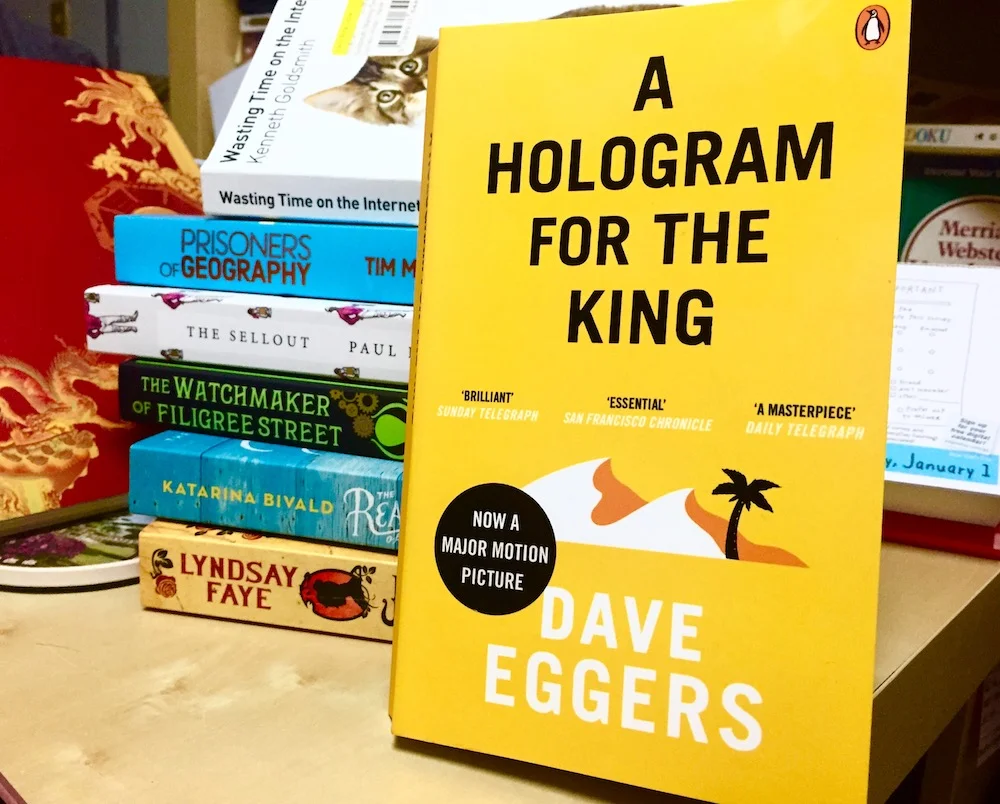
I picked up this novel without much thought during a book binge at Eslite in December, one of half a dozen paperbacks grabbed from the promotional tables near the registers. After quickly reading another of my book binge finds, Orphan Train (recommended!), I thought I’d be able to finish another story by the end of 2016, but alas, it is now a new year and A Hologram for the King has become my first book of 2017. Here’s my review.
Fiction | Paperback | 312 pages
I picked up this novel during a book binge at Eslite in December, one of half a dozen paperbacks grabbed from the promotional tables near the registers. For whatever reason, I tend to be less picky when choosing from bookstores, and never leave with fewer than five books in tow. It may be that I'm a sucker for nice displays, or perhaps it’s due to the lack of reviews that might drive me off. Point being, I bought this particular book without much thought.
After quickly reading another of my book binge finds, Orphan Train (recommended!), I thought I’d be able to finish another story by the end of 2016, but alas, it is now a new year and A Hologram for the King has become my first book of 2017. Here’s my review.
The bad news
Unfortunately, though I’d like to be able to say my 2017 reading is off to a good start, I found Eggers’s rambling narrative immensely sad. In this version of the cliched fish out of water tale, Alan Clay is a middle-aged white guy dispatched to a foreign land for a work assignment. Sound familiar?
Throughout the story, I found myself thinking I might have liked it more if I’d never seen Lost in Translation. Just as with Bill Murray in Coppola’s take on Tokyo, the world Clay encounters in Saudi Arabia is populated by unusual characters who contribute a touch of levity. And yet, you just know from the start that not one of the people in the story is going to be happy by the end. Changed, yes. Happy, no.
Perhaps if I’d listened to the Lost in Translation soundtrack while reading, I may have enjoyed this novel. Perhaps not.
The good news
Over the years, I’ve learned that no book is a waste of time, even if you don’t particularly like the content. There is always something to be learned. Here are a few things I learned from/after reading A Hologram for the King:
1. A movie version was released in April 2016
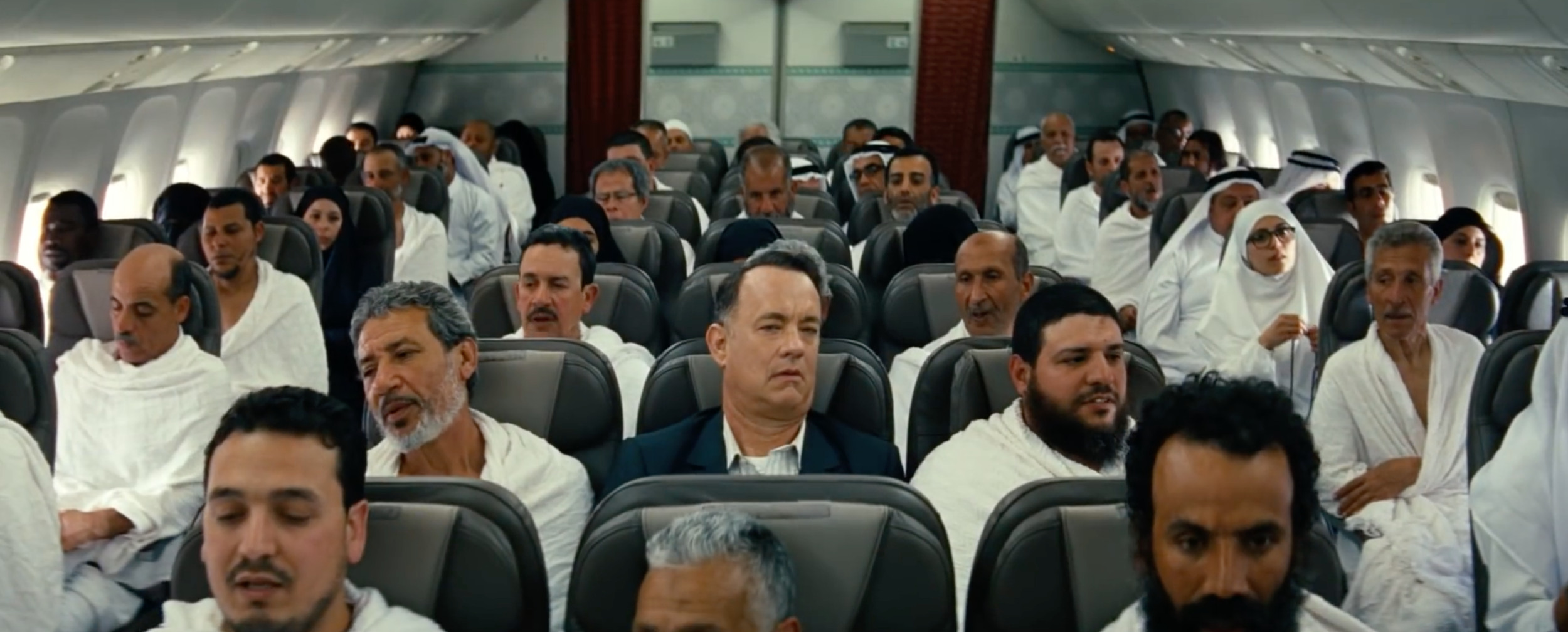
Naturally, it was after reaching the final page that I noticed the sticker on the bcover, proclaiming NOW A MAJOR MOTION PICTURE. A quick Google told me that the screen version of Alan Clay was portrayed by Tom Hanks (with his dad played by a now 83-year-old Tom Skerritt!), and that the film only took in US $7.8 million on a $30 million budget. Even the best actor who’s ever lived, Tom Hanks, couldn’t save this depressing story, and according to Wikipedia it was his worst flop in 30 years. See for yourself:
2. The book’s setting is real…ish

It was also after finishing the book that I learned that King Abdullah Economic City, Clay’s destination in the story, does in fact exist. And like the fictionalized version in Eggers’s novel, the real KAEC has a certain aura of the surreal about it. If you check out the official website and view its associated Facebook page, YouTube channel, and other social media accounts, you’ll notice the content is primarily drawn from the same source video, recycled and reconfigured over the past two years into new content. While you can find plenty of English language reporting over the past couple of years about the economic troubles of Saudi Arabia, there is very little recent reporting about KAEC itself that is not from an official press release.
Probably the best way to learn more about KAEC is to go there — if you’re looking for a new adventure in 2017 and moving to Saudi Arabia seems like a good personal choice, may I direct you to the recruiting page? Even women are welcome to apply.
3. There’s much to be learned about Middle Eastern fashion
Since A Hologram for the King includes numerous descriptions of what people are wearing, and given that I've never traveled to Saudi Arabia or anywhere else in the region, I had to do more Googles to be able to picture some of the characters in the novel. Down the rabbit holes of Wikipedia and YouTube and back out again, now I know a thing or two about thobes and how there’s no one correct way to wear a ghutra, but more importantly, I’ve got a better picture of the scale of what I do not know. But hey, knowing what you don't know is the first step in learning, right? If you’d like to learn a thing or two, here’s a good place to start:
Note: This video is from Qatar rather than Saudi Arabia, though the basics are similar.
—
And that’s all for book #1 of 2017 and the year's first book review. For some background, after 2 years in a row of successfully reading at least 52 books in 52 weeks, I decided a couple months back that my writing could also use some work. Writing reviews of what I'm reading is my way of upping the ante in 2017.
Stay tuned for reviews of other current reads, including:
Wasting Time on the Internet (Non-Fiction) by Kenneth Goldsmith
Monkey Mind (Non-Fiction) by Daniel Smith
The Watchmaker of Filigree Street (Fiction) by Natasha Pulley
To avoid missing out, be sure to subscribe below!

Watch this space
This site has long been a testing ground for things I'm working on for professional marketing tasks. Consider this a buffer post while I prepare new (actual) content for 2017.
Changes are afoot. Shuffling a few things around here.
While you wait, check out my portfolio, or Taiwan Startup Stadium (my main squeeze). You can also subscribe to Taipei Startup Digest, which I curate.
Photo credit: Gratisography
Non-Fiction | Audiobook | 11h30m
When it comes to the non-fiction books that really stick with me, I'd say books about the future rank mostly highly. Kevin Kelly's The Inevitable is one of a number of books published in 2016 dealing with technological evolution and how it will impact our world -- should you read it? Here's my opinion.